Regulation on Transparency and Market Abuse in Energy and Environmental Markets Published
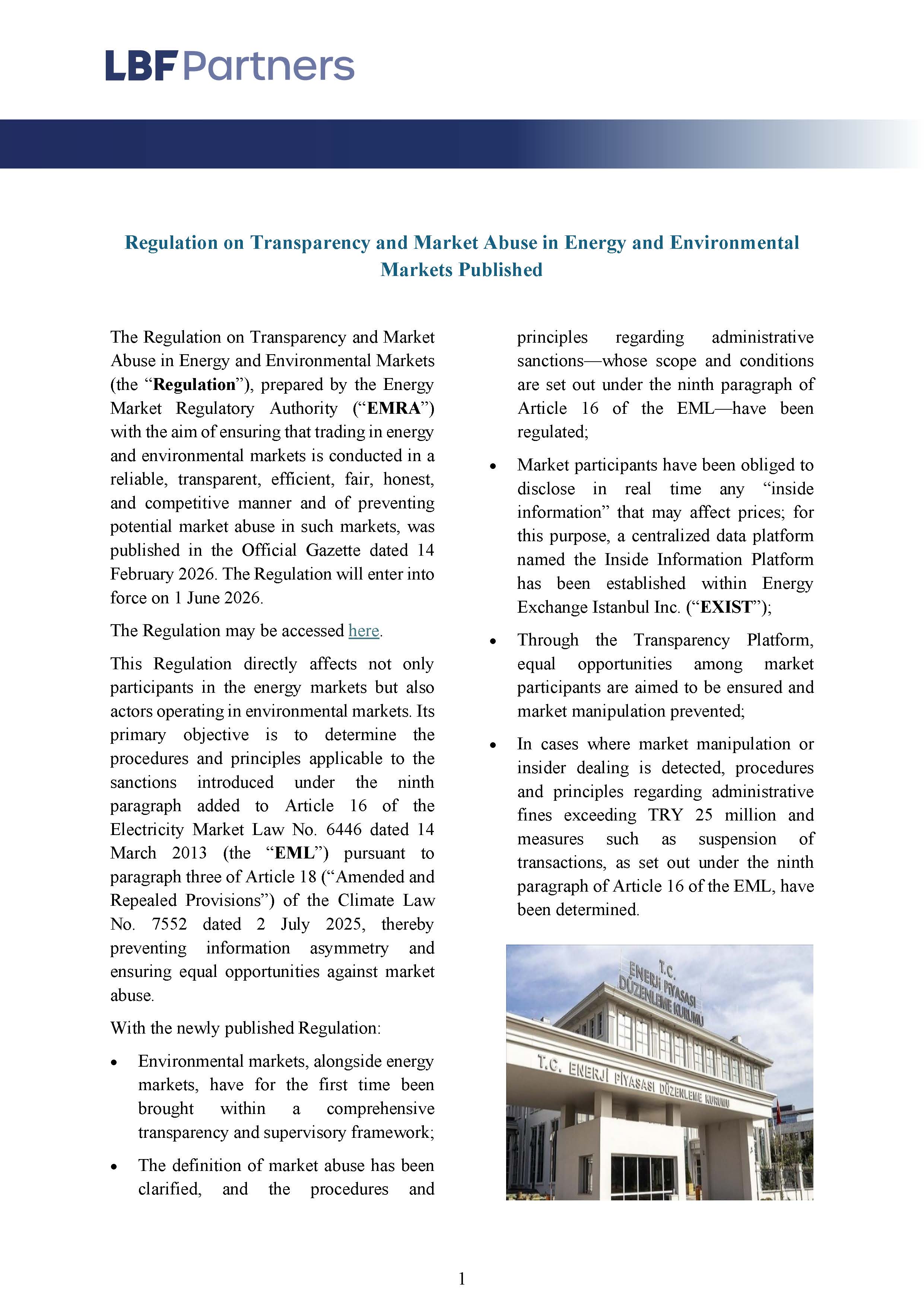
The Regulation on Transparency and Market Abuse in Energy and Environmental Markets (the “Regulation”), prepared by the Energy Market Regulatory Authority (“EMRA”) with the aim of ensuring that trading in energy and environmental markets is conducted in a reliable, transparent, efficient, fair, honest, and competitive manner and of preventing potential market abuse in such markets, was published in the Official Gazette dated 14 February 2026. The Regulation will enter into force on 1 June 2026.
The Regulation may be accessed here.
This Regulation directly affects not only participants in the energy markets but also actors operating in environmental markets. Its primary objective is to determine the procedures and principles applicable to the sanctions introduced under the ninth paragraph added to Article 16 of the Electricity Market Law No. 6446 dated 14 March 2013 (the “EML”) pursuant to paragraph three of Article 18 (“Amended and Repealed Provisions”) of the Climate Law No. 7552 dated 2 July 2025, thereby preventing information asymmetry and ensuring equal opportunities against market abuse.
With the newly published Regulation:
• Environmental markets, alongside energy markets, have for the first time been brought within a comprehensive transparency and supervisory framework;
• The definition of market abuse has been clarified, and the procedures and principles regarding administrative sanctions—whose scope and conditions are set out under the ninth paragraph of Article 16 of the EML—have been regulated;
• Market participants have been obliged to disclose in real time any “inside information” that may affect prices; for this purpose, a centralized data platform named the Inside Information Platform has been established within Energy Exchange Istanbul Inc. (“EXIST”);
• Through the Transparency Platform, equal opportunities among market participants are aimed to be ensured and market manipulation prevented;
• In cases where market manipulation or insider dealing is detected, procedures and principles regarding administrative fines exceeding TRY 25 million and measures such as suspension of transactions, as set out under the ninth paragraph of Article 16 of the EML, have been determined.
This briefing note explains in detail the innovations introduced by the Regulation and the new period envisaged in the markets under the headings below.
1. Prevention of Information Asymmetry and Principles of Data Disclosure
Article 5 of the Regulation mandates EXIST to establish and operate a centralized data platform called the Inside Information Platform to ensure public disclosure of inside information in energy and environmental markets.
The inside information required to be disclosed through this platform includes information relating to the capacity and utilization status of production, storage, consumption, and transmission facilities of market participants, as well as any critical data that may affect the trading decisions of a prudent market participant.
Pursuant to the Regulation, the minimum data to be disclosed on the platform, as well as the timing and format of publication, shall be determined by the Energy Market Regulatory Board (the “Board”). EXIST is responsible for ensuring data security, while market participants are required to establish the necessary technical infrastructure and notify the authorized persons.
The main function of the Inside Information Platform is to eliminate information asymmetry among market participants and to enable all actors to operate on an equal footing. Timely and accurate disclosure of price-sensitive information ensures that trading is conducted in a transparent, fair, reliable, and competitive manner.
Through this centralized structure, it is aimed to prevent market abuse and misuse of information and thereby ensure sustainable market efficiency and predictability in energy and environmental markets.
2. Transparency Platform: Centralized Data Management and Disclosure of General Market Data
Article 6 of the Regulation governs the establishment, operation, and data publication principles of the Transparency Platform, which enables the centralized disclosure of general market data to enhance transparency and predictability in energy and environmental markets.
Under this provision, EXIST is required to operate a centralized data platform to publish general market data—such as price, volume, and similar information—falling outside the scope of inside information. EMRA determines which data will be published, as well as the timing and format thereof. EXIST is authorized to obtain such data from relevant institutions.
Data security constitutes a fundamental principle of the platform’s operation. As a rule, trade secrets and data revealing the identity of market participants shall not be disclosed; however, matters of critical importance for the overall market constitute exceptions to this rule.
The primary function of the Transparency Platform is to ensure that trading in energy and environmental markets is conducted in a transparent, reliable, fair, and competitive manner. Accordingly, the Regulation aims to provide a statutory basis for the necessary data infrastructure to prevent market abuse and enhance market efficiency, thereby increasing market predictability.
3. Obligation to Disclose Inside Information, Conditions for Delayed Disclosure, and Reporting of Violations
Under Article 4 (“Definitions”) of the Regulation, “Inside Information” is defined as information relating directly or indirectly to energy and environmental products which has not been publicly disclosed and which, if disclosed, would be likely to have a significant effect on the prices of such products, concerning events that have occurred or are reasonably expected to occur.
Article 7 introduces an obligation for market participants to disclose, in full, accurately, and without delay, the inside information determined by the Board and any changes thereto via the Inside Information Platform.
The Regulation provides an exception allowing delayed disclosure for the purpose of protecting legitimate interests of market participants, provided that all of the following conditions are met: (i) the delay is not likely to mislead the public, (ii) the confidentiality of the information is ensured, and (iii) no trading decisions regarding energy and environmental products are made on the basis of such information.
Market participants are required to notify EXIST of the inside information whose disclosure has been delayed and the reasons for such delay. If the reasons are deemed unjustified or if the disclosure obligation is violated, administrative fines and sanction procedures shall be initiated by EMRA upon reporting by EXIST.
This framework provides an important supervisory mechanism to ensure full and accurate disclosure of inside information, establish a transparent, fair, and competitive trading environment, and prevent disruptive activities such as market manipulation.
4. Insider Dealing: Prohibited Conduct and Responsible Parties
Article 8 strictly prohibits persons possessing inside information in energy and environmental markets from using such information to gain an unfair advantage.
Under the Regulation, executing transactions on the basis of inside information, disclosing such information to third parties outside professional duties, or making recommendations to third parties based on such information are defined as “insider dealing.”
The scope of persons subject to these prohibitions is broad, including managers and shareholders of market participants, persons who have access to information due to their duties, and even individuals who know or should know the nature of the information or who obtain it through unlawful means.
If the violation is committed by a legal entity, natural persons involved in the decision-making process shall also be directly subject to sanctions.
To enhance deterrence, administrative fines exceeding TRY 25 million for market participants and TRY 2.5 million for natural persons are envisaged for insider dealing.
5. Prohibition of Market Manipulation and Dissemination of Misleading Information
Article 9 comprehensively defines acts constituting market manipulation and attempts thereof in energy and environmental markets.
Accordingly, in relation to energy or environmental products, the following acts constitute market manipulation:
• Giving false or misleading signals regarding the supply, demand, or price of products;
• Artificially fixing prices at abnormal levels without legitimate justification;
• Using fraudulent methods to provide false or misleading signals regarding supply, demand, or prices;
• Abusing market rules or acting to the detriment of other participants by submitting bids, executing transactions, modifying or cancelling existing bids or transactions, or linking bids.
The dissemination of misleading information through media or the internet is also prohibited. Where such acts are committed by a legal entity, natural persons involved in the decision-making process shall likewise be subject to sanctions.
For manipulative activities whose scope and conditions are determined under the ninth paragraph of Article 16 of the EML and the Regulation, administrative fines exceeding TRY 25 million and serious measures such as temporary trading bans are envisaged.
6. Duties and Responsibilities of Market Participants
Article 10 imposes critical duties on market participants to ensure that energy and environmental markets operate securely and transparently. Market participants are required to identify, safeguard, and effectively disclose inside information through the Inside Information Platform and to notify EXIST of the persons authorized to operate on the platform.
They must also promptly inform EMRA and the relevant market operator of any suspicion or knowledge of market abuse and submit all requested information and documents in a complete and timely manner within the scope of supervisory or audit activities.
This provision establishes a legal supervisory infrastructure to prevent market manipulation and insider dealing and to ensure the continued reliability of energy markets.
7. Duties and Responsibilities of Market and System Operators
Article 11 requires market operators to establish and operate a specialized “market surveillance unit” to ensure a reliable, transparent, and competitive trading environment.
Market operators are authorized to request information and documents directly from market participants and are obliged to report suspicious findings to EMRA without delay.
Each system operator is required to provide the necessary data to market operators for the fulfillment of surveillance obligations. Both market and system operators must establish the technical infrastructure enabling continuous and real-time access to the data required by EMRA for supervisory activities.
This structure aims to eliminate supervisory gaps by mandating data sharing between operators and granting EMRA direct oversight access.
8. Surveillance and Enforcement Mechanism: Administrative Sanctions and Deterrent Measures
Articles 12, 13, and 14 establish a comprehensive supervisory and sanctioning framework for detecting, penalizing, and mitigating the adverse effects of market abuse.
EMRA is authorized to conduct surveillance and audits ex officio or upon complaint and is vested with broad powers, including on-site inspections, access to information systems, and requests for any documents.
Article 13 provides for significant administrative fines for violations, with maximum amounts updated annually in line with the revaluation rate. If a benefit is obtained or damage is caused through violations, fines may be imposed at not less than twice the amount of the benefit obtained or damage incurred.
In determining the fine, objective criteria such as the duration of the violation, its impact on market prices, and the offender’s net sales revenue shall be considered.
In cases of strong suspicion or determination of market abuse, the Board is authorized to promptly impose protective measures such as:
• Requesting additional collateral;
• Freezing receivables;
• Suspending bids; or
• Imposing temporary trading bans.
Measures applied by market operators shall be immediately submitted for the Board’s approval. The Board may decide on their continuation, amendment, or removal, or impose additional measures to ensure the effective and sound functioning of the markets.
9. Preparation of Guidelines, Entry into Force, and Implementation
The final section of the Regulation governs the preparation of guidelines, the entry into force, and administrative responsibility.
EMRA is obliged to prepare and publish a guideline to provide guidance to market participants regarding inside information and market abuse, ensure uniform implementation, and eliminate uncertainties. The President of EMRA is responsible for the execution of the Regulation.
The Regulation will officially enter into force on 1 June 2026.
For further information and support, please contact us.
The Regulation may be accessed here.
This Regulation directly affects not only participants in the energy markets but also actors operating in environmental markets. Its primary objective is to determine the procedures and principles applicable to the sanctions introduced under the ninth paragraph added to Article 16 of the Electricity Market Law No. 6446 dated 14 March 2013 (the “EML”) pursuant to paragraph three of Article 18 (“Amended and Repealed Provisions”) of the Climate Law No. 7552 dated 2 July 2025, thereby preventing information asymmetry and ensuring equal opportunities against market abuse.
With the newly published Regulation:
• Environmental markets, alongside energy markets, have for the first time been brought within a comprehensive transparency and supervisory framework;
• The definition of market abuse has been clarified, and the procedures and principles regarding administrative sanctions—whose scope and conditions are set out under the ninth paragraph of Article 16 of the EML—have been regulated;
• Market participants have been obliged to disclose in real time any “inside information” that may affect prices; for this purpose, a centralized data platform named the Inside Information Platform has been established within Energy Exchange Istanbul Inc. (“EXIST”);
• Through the Transparency Platform, equal opportunities among market participants are aimed to be ensured and market manipulation prevented;
• In cases where market manipulation or insider dealing is detected, procedures and principles regarding administrative fines exceeding TRY 25 million and measures such as suspension of transactions, as set out under the ninth paragraph of Article 16 of the EML, have been determined.
This briefing note explains in detail the innovations introduced by the Regulation and the new period envisaged in the markets under the headings below.
1. Prevention of Information Asymmetry and Principles of Data Disclosure
Article 5 of the Regulation mandates EXIST to establish and operate a centralized data platform called the Inside Information Platform to ensure public disclosure of inside information in energy and environmental markets.
The inside information required to be disclosed through this platform includes information relating to the capacity and utilization status of production, storage, consumption, and transmission facilities of market participants, as well as any critical data that may affect the trading decisions of a prudent market participant.
Pursuant to the Regulation, the minimum data to be disclosed on the platform, as well as the timing and format of publication, shall be determined by the Energy Market Regulatory Board (the “Board”). EXIST is responsible for ensuring data security, while market participants are required to establish the necessary technical infrastructure and notify the authorized persons.
The main function of the Inside Information Platform is to eliminate information asymmetry among market participants and to enable all actors to operate on an equal footing. Timely and accurate disclosure of price-sensitive information ensures that trading is conducted in a transparent, fair, reliable, and competitive manner.
Through this centralized structure, it is aimed to prevent market abuse and misuse of information and thereby ensure sustainable market efficiency and predictability in energy and environmental markets.
2. Transparency Platform: Centralized Data Management and Disclosure of General Market Data
Article 6 of the Regulation governs the establishment, operation, and data publication principles of the Transparency Platform, which enables the centralized disclosure of general market data to enhance transparency and predictability in energy and environmental markets.
Under this provision, EXIST is required to operate a centralized data platform to publish general market data—such as price, volume, and similar information—falling outside the scope of inside information. EMRA determines which data will be published, as well as the timing and format thereof. EXIST is authorized to obtain such data from relevant institutions.
Data security constitutes a fundamental principle of the platform’s operation. As a rule, trade secrets and data revealing the identity of market participants shall not be disclosed; however, matters of critical importance for the overall market constitute exceptions to this rule.
The primary function of the Transparency Platform is to ensure that trading in energy and environmental markets is conducted in a transparent, reliable, fair, and competitive manner. Accordingly, the Regulation aims to provide a statutory basis for the necessary data infrastructure to prevent market abuse and enhance market efficiency, thereby increasing market predictability.
3. Obligation to Disclose Inside Information, Conditions for Delayed Disclosure, and Reporting of Violations
Under Article 4 (“Definitions”) of the Regulation, “Inside Information” is defined as information relating directly or indirectly to energy and environmental products which has not been publicly disclosed and which, if disclosed, would be likely to have a significant effect on the prices of such products, concerning events that have occurred or are reasonably expected to occur.
Article 7 introduces an obligation for market participants to disclose, in full, accurately, and without delay, the inside information determined by the Board and any changes thereto via the Inside Information Platform.
The Regulation provides an exception allowing delayed disclosure for the purpose of protecting legitimate interests of market participants, provided that all of the following conditions are met: (i) the delay is not likely to mislead the public, (ii) the confidentiality of the information is ensured, and (iii) no trading decisions regarding energy and environmental products are made on the basis of such information.
Market participants are required to notify EXIST of the inside information whose disclosure has been delayed and the reasons for such delay. If the reasons are deemed unjustified or if the disclosure obligation is violated, administrative fines and sanction procedures shall be initiated by EMRA upon reporting by EXIST.
This framework provides an important supervisory mechanism to ensure full and accurate disclosure of inside information, establish a transparent, fair, and competitive trading environment, and prevent disruptive activities such as market manipulation.
4. Insider Dealing: Prohibited Conduct and Responsible Parties
Article 8 strictly prohibits persons possessing inside information in energy and environmental markets from using such information to gain an unfair advantage.
Under the Regulation, executing transactions on the basis of inside information, disclosing such information to third parties outside professional duties, or making recommendations to third parties based on such information are defined as “insider dealing.”
The scope of persons subject to these prohibitions is broad, including managers and shareholders of market participants, persons who have access to information due to their duties, and even individuals who know or should know the nature of the information or who obtain it through unlawful means.
If the violation is committed by a legal entity, natural persons involved in the decision-making process shall also be directly subject to sanctions.
To enhance deterrence, administrative fines exceeding TRY 25 million for market participants and TRY 2.5 million for natural persons are envisaged for insider dealing.
5. Prohibition of Market Manipulation and Dissemination of Misleading Information
Article 9 comprehensively defines acts constituting market manipulation and attempts thereof in energy and environmental markets.
Accordingly, in relation to energy or environmental products, the following acts constitute market manipulation:
• Giving false or misleading signals regarding the supply, demand, or price of products;
• Artificially fixing prices at abnormal levels without legitimate justification;
• Using fraudulent methods to provide false or misleading signals regarding supply, demand, or prices;
• Abusing market rules or acting to the detriment of other participants by submitting bids, executing transactions, modifying or cancelling existing bids or transactions, or linking bids.
The dissemination of misleading information through media or the internet is also prohibited. Where such acts are committed by a legal entity, natural persons involved in the decision-making process shall likewise be subject to sanctions.
For manipulative activities whose scope and conditions are determined under the ninth paragraph of Article 16 of the EML and the Regulation, administrative fines exceeding TRY 25 million and serious measures such as temporary trading bans are envisaged.
6. Duties and Responsibilities of Market Participants
Article 10 imposes critical duties on market participants to ensure that energy and environmental markets operate securely and transparently. Market participants are required to identify, safeguard, and effectively disclose inside information through the Inside Information Platform and to notify EXIST of the persons authorized to operate on the platform.
They must also promptly inform EMRA and the relevant market operator of any suspicion or knowledge of market abuse and submit all requested information and documents in a complete and timely manner within the scope of supervisory or audit activities.
This provision establishes a legal supervisory infrastructure to prevent market manipulation and insider dealing and to ensure the continued reliability of energy markets.
7. Duties and Responsibilities of Market and System Operators
Article 11 requires market operators to establish and operate a specialized “market surveillance unit” to ensure a reliable, transparent, and competitive trading environment.
Market operators are authorized to request information and documents directly from market participants and are obliged to report suspicious findings to EMRA without delay.
Each system operator is required to provide the necessary data to market operators for the fulfillment of surveillance obligations. Both market and system operators must establish the technical infrastructure enabling continuous and real-time access to the data required by EMRA for supervisory activities.
This structure aims to eliminate supervisory gaps by mandating data sharing between operators and granting EMRA direct oversight access.
8. Surveillance and Enforcement Mechanism: Administrative Sanctions and Deterrent Measures
Articles 12, 13, and 14 establish a comprehensive supervisory and sanctioning framework for detecting, penalizing, and mitigating the adverse effects of market abuse.
EMRA is authorized to conduct surveillance and audits ex officio or upon complaint and is vested with broad powers, including on-site inspections, access to information systems, and requests for any documents.
Article 13 provides for significant administrative fines for violations, with maximum amounts updated annually in line with the revaluation rate. If a benefit is obtained or damage is caused through violations, fines may be imposed at not less than twice the amount of the benefit obtained or damage incurred.
In determining the fine, objective criteria such as the duration of the violation, its impact on market prices, and the offender’s net sales revenue shall be considered.
In cases of strong suspicion or determination of market abuse, the Board is authorized to promptly impose protective measures such as:
• Requesting additional collateral;
• Freezing receivables;
• Suspending bids; or
• Imposing temporary trading bans.
Measures applied by market operators shall be immediately submitted for the Board’s approval. The Board may decide on their continuation, amendment, or removal, or impose additional measures to ensure the effective and sound functioning of the markets.
9. Preparation of Guidelines, Entry into Force, and Implementation
The final section of the Regulation governs the preparation of guidelines, the entry into force, and administrative responsibility.
EMRA is obliged to prepare and publish a guideline to provide guidance to market participants regarding inside information and market abuse, ensure uniform implementation, and eliminate uncertainties. The President of EMRA is responsible for the execution of the Regulation.
The Regulation will officially enter into force on 1 June 2026.
For further information and support, please contact us.


 Download PDF

 s.kayikci@lbfpartners.com